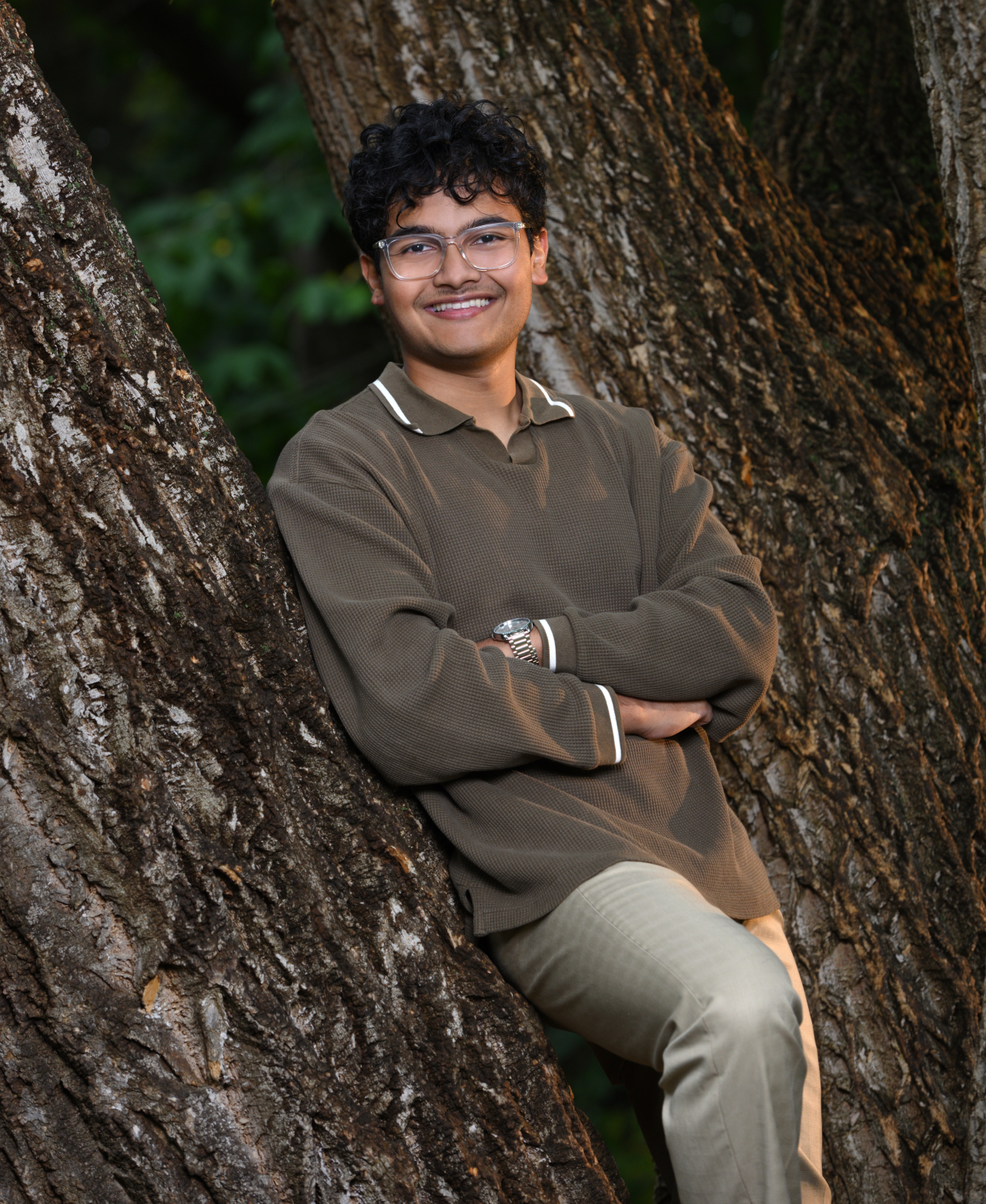
Arkesh Das
MSU College of Natural Science
More about me:
What is your major and anticipated graduation?
Biotechnology and Data Science, May 2026
How did you decide to attend MSU?
When I was a high school senior, I took part in the Alumni Distinguished Scholarship competition. After completing the in-person exam in the morning, I decided to stay and attend the rest of the events throughout the day so I could get a feel for the campus. Everyone that I interacted with, from the students at the club fairs and research panels, to the faculty and staff at the academic presentations seemed so passionate and supportive of each other’s success, which was something that I didn’t really see at any of the other colleges I visited.
I was also a runner-up in the Alumni Distinguished Scholarship competition, and I was accepted into the Professorial Assistantship program through the honors college. Both of these opportunities greatly influenced my decision to attend MSU, and have allowed me to challenge myself and explore a wide variety of my interests in a way that I don’t think I would quite be able to had I chosen to go elsewhere.
How did you select your major?
My primary major is biochemistry/biotechnology. I’ve always been interested in learning
the
mechanisms behind how different things work in the body, and I think biotechnology
is a very
rewarding major because it is the intersection of so many of the different natural
sciences, from
biology and chemistry to things like genomics, bioinformatics and data science.
A lot of modern scientific and clinical research requires an understanding of computers and statistics, and I think that the data science major at MSU has allowed me to be exposed to a blend of both. Learning data structures and algorithms forced me to approach problems in a structured, logical way, and over time I began to appreciate that skill as much as the technical content itself. I think this kind of thinking, along with the broader understanding of data and computation, will be increasingly important in a future where AI and data science are central to almost every field. For me, it is also a mindset I can carry into medicine, where breaking down complex problems step by step is often the key to finding the right path forward.
Can you describe your research?
- Sorghum project: We are trying to use biofuel crops to easily make valuable chemicals that are hard to find and produce. Many of these chemicals can be used in medicine as well as other fields.
- Psychology project: Trying to use statistics and probability to understand how people think
about and apply stereotypes.
What is the societal impact of your research?
Terpenes are an incredibly diverse class of molecules with uses in medicine, fragrances, and food. Many of them, like the cancer drug Taxol, are rare and expensive to produce because they can only be harvested in tiny amounts from slow-growing endangered plants such as the Pacific Yew. By identifying the genes responsible for terpene biosynthesis, we could engineer fast-growing crops like sorghum to produce these compounds directly. This would make life-saving treatments like Taxol cheaper and more widely available, while also reducing the need for environmentally destructive harvesting. This would both increase global access to critical medicines and create a more sustainable way of producing these rare natural products.
Stereotypes are often seen as intangible or subjective, which makes them hard to define and study rigorously. However, modeling stereotypic traits mathematically turns them into something measurable. By creating empirical standards for what traits are associated with different groups, we can uncover the hidden biases people carry without realizing it. This knowledge is crucial for designing interventions in education, hiring, and policy that address those subconscious biases. This could provide a concrete tool for reducing discrimination and promoting equity, helping institutions implement measurable, evidencebased change.
How has your undergraduate experience been impacted by research experience?
Because of the pandemic, I missed out on many of the hands-on experiences in my classes.
Most of the “virtual labs” were just watching someone else do the procedure over Zoom,
and for me that created a real disconnect. Techniques like gel electrophoresis or
restriction digests felt like
memorizing steps with no deeper meaning, and I’d usually forget them as soon as the
test was over. Being able to actually work in research labs changed that. Using PCR,
primer construction, and other techniques almost daily made those abstract concepts
finally click, and I found myself connecting class material to what I was doing in
the lab. The psychology research I joined also gave me a way to apply the data science
tools I was learning in class to real problems, which helped me see how coding and
statistical models could be used to study something as human as stereotypes and bias.
Of everything you have experienced at MSU, what has surprised you the most/what is something you never expected:
Last year, when I was helping set up and organize the Undergraduate Research and Arts
Forum, I got the chance to walk around and talk to a lot of the presenters. I knew
there would be variety, but I was struck by just how diverse the project topics were,
from criminal justice research on
incarcerated youth to models predicting how diseases spread through mosquito populations.
I also gave feedback on video submissions and got to see the opportunities that other
students were pursuing in fields I never would have thought of, from theater internships
in Texas to art pieces that fused ancient Japanese traditions with contemporary design.
Seeing all of this gave me a new appreciation for the range of things people are doing
at MSU, and how much creativity and curiosity exists across all the different colleges.
Plans after graduation?
I was accepted into medical school at the University of Toledo, through their MedStart
program,
and I will be starting in July.
How important is this scholarship to you personally and to your future career?
I hope that as a Dean’s Research Scholar I’ll be able to continue to improve my speaking
and
presentation skills. I think that being able to break down and communicate scientific
research to general audiences is almost as important as conducting research itself,
especially when it comes to educating future generations, since getting them interested
in scientific careers is what will lead to more scientific progress in the future.